Matthew 5:17-20
Excerpts from Gary Hamrick’s Sermon
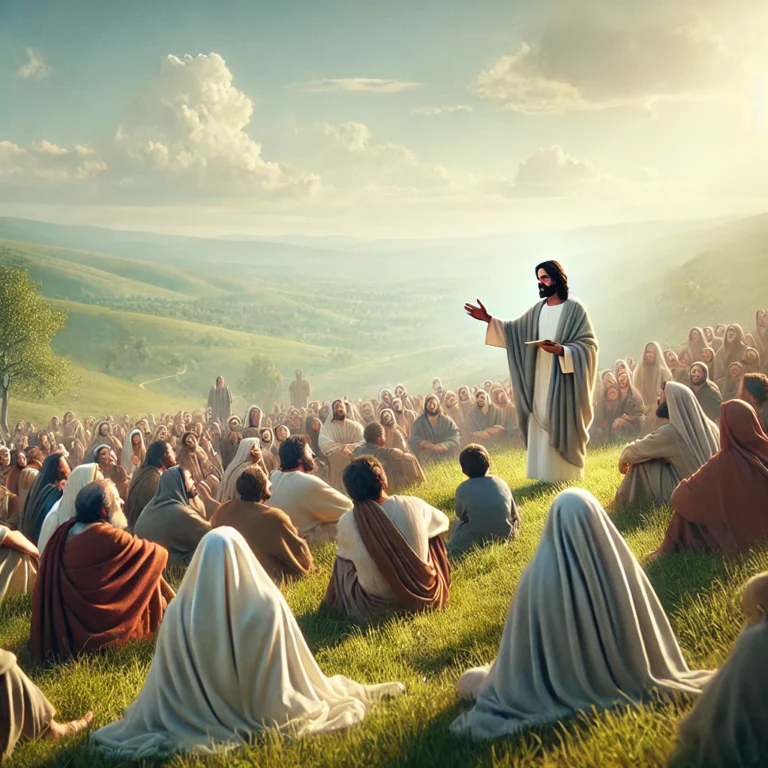
Let me take you to the setting on the northern coast of the Sea of Galilee, where Jesus delivers his longest recorded sermon. So I want to mentally transport you to the hill in this picture, where you can enjoy this beautiful scenery.
Imagine sitting there listening to Jesus teaching the Sermon on the Mount. And he says: Do not think that I have come to abolish what has been commanded and predicted in the Old Testament. On the contrary, I came to make it all done and complete it. I assure you that as long as heaven and earth last, nor a letter or a comma from what God has commanded, will not lose its validity until it is fulfilled. And therefore anyone who does not take even the smallest commandment seriously and thus leads people will be the last in God’s kingdom. But he who follows God’s commands and thus learns others will be great in the kingdom of heaven. Remember: If you want to enter the kingdom of heaven, you must be more than a formal fulfillment of orders and prohibitions, as the Teachers of Law and Pharisees do. (Matthew 5:17-20)
Here, Jesus points out how important it is to follow the teachings in the Bible and do what the Bible says. He emphasizes here that even the smallest parts of the script, such as the smallest letter of the Hebrew alphabet, are important. In other words, he says that even the smallest detail of his word will survive the present heaven and earth. The Bible tells us that one day there will be a new heaven and a new earth, but nothing, not even the smallest detail of God’s word, will be lost. And also that it should not be manipulated. Because Everything in God’s word aims to speak to us as God’s revelation to mankind, Including the Old Testament.
So today we will talk about what exactly Jesus meant and what is the meaning of us.
At the beginning of verse 17, Jesus emphasizes: ‘Do not think that I have come to abolish what has been commanded and predicted in the Old Testament. On the contrary, I came to make it all done and complete (Filled).Again, he speaks here about the validity and importance of the whole Word of God from Genesis to Revelation.
You may have wondered what the Old Testament actually has for us. What are the benefits of Old Testament writings? If you’ve read anything about them, you know they are full of many rules, rituals and prescriptions. Not to mention the parts that deal with diseases, bloodshed and wars. So you may be asking, Does the Old Testament have any significance for our lives today? Are we not under the new law? Why do we even need to read and study the Old Testament? And if you have ever compared the way God presents himself in the Old Testament and the New Testament, some of you may have thought: ‘I like the New Testament, God is my Father in it. In the Old Testament, it appears more like a mafia godfather.’
Some of you trip over it and say to yourself: ‘Why do we need the Old Testament at all? It’s really hard, it’s a bit dark, there’s a lot of death in it, a lot of illness, bloodshed, wars and so on.’ If you’ve ever thought about it, you’re not alone.
Yet here Jesus begins with beatitudes in his longest recorded sermon and says at the very beginning: ‘I did not come to repeal the old law, …But to fill it.’
So there must be some important reason why it is necessary to read the Old Testament together with the New Testament and understand what God is trying to show us through both. So what does Jesus mean when he says that he did not come to abolish or destroy him, but to fill him? A What specifically does this mean for us?
To understand what it means we must speak about the purpose of the Old Testament. Let’s start by talking about the division of the Old Testament to understand how to read. There are three parts or categories of laws.
1. Ceremonial Laws +
2. Dining laws +
3. Moral Laws
Because if you look at the nuances of how different laws are formulated, their details and what God emphasizes, they all fall into one of these three categories.
Note that for points number one and number two, I gave a cross+. it is because Ceremonial and dietary aspects of the law are no longer binding. However, the moral code is still there and I will explain it here one by one. First, let me talk about ceremonial laws and what they were intended for.
Ceremonial Laws
If you look at the Old Testament, you will find there certain rules that God gave to his people to follow and He thus differed from the pagan peoples around him.
In ancient biblical times, in the period of the Old Testament, God wanted to distinguish his people, the Israelites, from the pagan neighbors around them, and thus issued certain ceremonial laws to distinguish them from them. These included things such as – how to dress, even how to cut your hair, would include issues of hygiene, including feasts and celebrations, ritual purification, worship practices and other categories. All instructions on how to stand out and remain separated in appearance and practices from pagan neighbors around them.
I will give you some examples here. – For example, men were told in Leviticus: ‘You won’t shave your sides or disfigure your beard edges.’ In other words, they were told to grow a beard and never shave in the temples area. To this day, Hasidic Jews in particular make this hair grow around their ears. Sometimes they film them or tie them behind their ears. They take it very literally.
The reason God said that was that The pagans around them shaved these parts of their heads to participate in pagan rituals. God says, “I don’t want you to participate in these rituals, so I don’t want you to shave your sides.” So he asked them to differentiate themselves from them in this way.
In the book Leviticus it is written that whoever has sinned has: bring to the priest as a sacrifice for the guilt of the ram from the herd, one without defect and the corresponding value. In this way, the priest will make reconciliation for him for inadvertently committed offenses and will be forgiven. It is a sacrifice for guilt when the man has committed an offense against the Lord. They sacrificed the life of the animal to make reconciliation for the life of the culprit.
The ceremonial law therefore involved ceremonial actions related to hygiene, clothing, haircuts and sacrifices.
eating laws
Then there is the eating aspect of the law. And the dietary laws aimed to keep God’s people healthy, there is a certain wisdom in that. Again This is not binding. You are not bound by these laws, but you might still want to practice some of these eating aspects for your personal health.
God divided certain animals into categories of pure and impure. The category of pure is what Jews call kosher. Then there were impure animals that were not allowed to be eaten. God introduced it as a rule of purity. In reality, however, it should have indicated a wider context. The idea that the true purity we need is not about food, but our heart. And we’ll get to that later in our studio today.
Here are some examples of some eating aspects of the law. Leviticus: The Lord spoke to Moses and Aaron and said to them, ‘Speak to the children of Israel and say to them: These are the animals that you may eat of all the animals that are on earth, those animals that have bifurcated hooves and are chewing, you are allowed to eat it.
According to these dietary laws, if the animal had its hooves and was chewing – it had to have both, then it was okay to eat it. If it had one or the other, but not both, you couldn’t eat it.
One of the most common animals, which even those who are not Jews know that the Jews must not eat them, if they follow these food laws, is pork. Pigs are therefore prohibited. And the Bible in Deuteronomy says: ‘The pig is impure for you, for it has split hooves, but it does not chew; you must not eat their meat or touch their dead bodies.’
If you want to strictly follow the laws of the pig’s laws, it means no bacon, no pork barbecue, no ham sandwiches.
And listen, it’s even worse: From everything in the water you can eat it, what has fins and scales; Must have both, whether in the sea or in rivers, you can eat it; But everything in the seas and rivers that has no fins and scales, everything that moves in the water, or any living creature that is in the water, is an abomination to you.
That means no shrimp, no crabs, no lobsters, no oysters… God says: ‘I don’t want you to eat any of that.’
Now you can choose in person again, as these are fish that eat from the bottom, it’s probably not the best to eat. You can decide that based on personal beliefs and that it may not be good for you. But when it comes to law-based restrictions, It’s still not binding.
These are the dietary laws. But we also have good news. Ceremonial and catering aspects of the Old Testament law are no longer binding. How do we know? Because of that, What Jesus says in the New Testament, and Paul also talks about it. These things were the image of Christ in terms of purity, the immaculateness, and ritual matters. were external, but pointed to the need for greater importance within. And so these were regulations introduced temporarily, to distinguish God’s people as the one that belongs to him. But The real problem is the heart.
In the New Testament, Paul wrote it in the Colossians: So let no one judge you for food or drink, for meal regulations, for holidays, new months, ceremonies or Sabbat, which are the shadow of things to come, but the essence is in Christ.
In other words, ceremonial and dietary aspects served for a certain period of time to distinguish God’s people from the rest of the pagan world. Therefore, God gave instructions regarding worship, hygiene, clothing, food and holidays until Christ comes to solve a larger problem, which was not external, but internal. This is the heart. Because you can take all the ritual baths in the world, you can celebrate all the holidays, you can have your hair cut exactly as it says, eat only kosher food, etc., and yet you will not be in harmony with God. Why? Because the problem is the heart. And that’s exactly what Jesus came to fix. And therefore the moral code is still in force because we need to regulate the heart. As you can see here in the Sermon on the Mountain. In my Bible there is a subtitle that says, That the murder begins in the heart, it is further written that adultery begins in the heart.
And when you look at other passages Jesus says: ‘You heard that it was said, ‘You shall not kill.’ (That’s command number 6.) And whoever kills will be subjected to judgment, but I tell you that anyone who is angry with their brother for no reason will be subject to judgment. What is he saying? He says that murder in fact It begins in the heart. That if you feel anger towards your brother or sister, when you feel bitter and angry, and if you can’t deal with it, you can kill someone. So he says that murder is actually a matter of the heart because that’s where it all starts. The same goes for adultery: You heard that it was said: ‘You will not commit adultery.’ (This is the seventh commandment of the ten commandments.) But Jesus says: ‘Whoever looks at a woman with lust, has already made a foreigner with her in his heart.’ So he says that the ceremonial aspects are related to the heart and that the laws of the law cannot correct the heart. The troubles we have with sin lie in coming from the heart. We have to fix our hearts.
The problem is that in Jesus’ time, people thought they could fix their hearts themselves. And people still think so today. That it is enough to do certain things, behave and act in a certain way, and thus one can correct one’s heart.
In fact, we cannot fix our hearts ourselves. That’s why Jesus came.
However, I’m getting ahead of myself a bit.
moral laws
the third category, is the moral dimension of the law. The moral laws that God gave are generally considered timeless, eternal and universal. Why? because they come from God’s character. For God is such that he does not want his children to live in a way that is contrary to his own character. I will give a few examples here:
When the Bible talks about not giving false testimony, in other words We are not to lie, is it because God is the Truth, and therefore does not want us to do something that contradicts his character.
When he says in Scripture not to be alienated, it is because it is because he is faithful And he wants us to be faithful.
When he says “don’t kill” it’s because He is the originator of life, and therefore wants us to respect life.
When he says “don’t be ruthless” it’s because it’s because He is merciful.
When he says “don’t be unkind” it’s because it’s because He is loving.
When he says “don’t be unjust” it’s because it’s because He is fair.
Do you get it? So, that’s the moral aspect when it comes to behavior.
God is saying, ‘This is my character, and I want you to live in a way that honors that character.’
So when we live in a way that dishonors this character, we violate God’s moral law. And therefore this moral law does not lose its validity.
And by the way, the moral law of the Bible became the very basis of the legal system. – Why can’t you murder someone, why can’t you rob someone? Because our law is based on biblical principles. This is why there are certain things that are enshrined in the law – what you can and cannot do.
So the moral code remains intact for us, not only as Christians, but also as the inhabitants, as biblical laws were originally the basis of law in our country. Now, as society gradually abandons God’s law, God’s word, and as a result, the laws that were once based on the Bible will soon be abandoned with it. When you begin to abandon the Bible, which is the foundation, then you begin to rewrite the laws, abandon the laws on which they were originally based. And this is what we see right now in many countries. When you have values other than writing as a basis for the law, then You start rewriting the laws themselves, and Then you become the benchmark you, and not God anymore.
If God’s moral code is still valid now, what is its purpose for us?
There is a triple purpose of the Old Testament regarding the moral code. These three reasons are intended to explain: What is sin, to reveal sin in us and finally express our need for the Savior.
1. What is sin
The first purpose of God’s moral code is to explain what sin is.
Some aspects of good and evil are intuitive, because we are made in God’s image and form. you know something is right and something is wrong, and No one needs to teach you, you just know it. I mean, if a three-year-old steals a neighbor’s toy from a child he’s playing with, what will he do? Hide her! Because he knows what it just did was wrong. It is something intuitive, something instinctive.
However, there are other things that they have to learn. Things that we may not be aware of instinctively or intuitively, and therefore we must learn them. Even Paul himself said it in the Romans: ‘I wouldn’t even know that I shouldn’t be envious if the law didn’t tell me: ‘Don’t envy your neighbor anything at all.’ (This is commandment number ten.) So Paul admitted: ‘You know, I envied the people what they had and who they were, and I didn’t even know it was bad until God clearly said to me: ‘That should not be done.’ And the same applies to us.
You may instinctively know that you should not kill anyone, but you may not know until you read the Bible, what Jesus also said about the murder, and that the murder begins in the heart. In the Ten Commandments it is written: ‘You shall not kill. Therefore, whoever killed must go to justice.’ But I tell you that everyone who is angry with their neighbor will be judged. Contempt for man is a crime, and whoever calls upon the other God’s punishment will fall into it himself. If you put your relationship with God in order and you realize that you have a discrepancy with someone, remove it and reconcile with it. Only then come before God. If you are not willing to reconcile with another person, your anger before God will sue you and you will not escape condemnation. It’s like a creditor leading you to a judge. If you don’t agree with him on the way, you will go to jail and pay off the entire debt. He says, ‘Listen, you may know it’s wrong to kill someone, but you may not know that it’s bad to keep bitterness and hatred in your heart. ‘ So we have to learn some things.
Sometimes people can’t forgive what someone has done to them. And as a Christian, until you read in the Bible that you should forgive, just as Jesus forgave you, so you don’t know. Why must we be told in the Bible? Because it’s not our automatic response. When someone insulted you or really hurt you, your instinct is not: ‘I’ll forget it.’ That’s not the first thing you can think of. In fact, first you say to yourself: ‘God, let him pay for it!’ etc. So I have to learn it. I need God and his help to be able to forgive the way he has forgiven me. It’s not easy, it won’t come by itself. We have to learn some of these things from the Bible.
And so God’s moral law explains to us what sin is. Maybe we wouldn’t know it if we didn’t read and understand what God expects from us. What God says is right and what God says is wrong, and so we have to learn.
2. Reveals sin in us
Second, the moral law reveals the sin in us. When we read in the Bible about some moral code, we suddenly realize sin in our own heart. The Bible says in the Galatians 2:16: But we know that man does not become righteous before God based on the works commanded by law, but by faith in Christ Jesus. In other words, you can’t work or deserve a trip to heaven. He says: ‘The law is the knowledge of sin.’ (Romans 3:20) The law was given in part to realize the sin in my own heart.
Let me illustrate it like this: When someone is sick, you pull out the thermometer and take their temperature. But the thermometer itself has no healing effects, it can only tell you that you are sick. The law cannot cure you, it can only reveal that you are spiritually ill. The law itself is not a medicine that would heal you, but it reflects the fact that you are sick, that you are sinful.
3. Shows the need of the Savior (savior)
And finally, thirdly, the purpose of the moral law is to express our need for someone who would help us with it, who would save us from our state – the savior, the savior.
Paul said it in Galatian: ‘Now that faith has come, we are no longer under the supervision of the law.’ Why? Well, because what’s stronger? The relationship I have with Jesus that guides my heart, or reading a lot of rules and prescriptions?
Before Jesus came, people only had a law at their disposal that helped regulate the heart. When Jesus died on the cross for our sins, a change occurred. Now we have a relationship with him that leads our hearts. It is a relationship based on love, not a law-based relationship. it is therefore Much greater motivation, when you have a love affair with someone and want to make them happy and show respect, and so it is with Jesus. However, if it is only a written law, it is not such a strong relationship.
Paul says in the Galatians that the purpose of the law was to reveal the fact that I have sin in my heart. And how do I fix it? How do I reconcile with God when I have all these sins? If you read all the commandments, of which there are over 600 in the Old Testament, is it even possible to fulfill them all? No, you are always behind God’s glory. In fact, that’s exactly what the Bible says: All have sinned and are far away from God. Rome 3:23 None of us meet God’s standards.
There are two ways to try to fix it. The first way is bad and doesn’t work, and it was often done by the Pharisees in the time of Jesus, and some people still do it today. It looks like this: they understand well what sin is. They read the Bible, and the sin is explained there, and if they have at least an iota of self-awareness, they realize that they are sinners. They do it right. sees their broken state and how much they can’t fix themselves, but then Instead of relying on God, they make their own efforts. They try to be good people and do many good deeds and many noble things and be very charitable. I see it all the time in our world.
How people who do not know Jesus try to do many things to calm their own remorse. – “They’re doing this good thing and then that good thing…etc.” And some of those things are really admirable. I’m not saying it’s bad, but I feel the motivation in it. The motivation is that they start, for example, the initiative for clean water so that all people around the world have clean water. But the question is, why do they do it? Is it because they really have a heartbreak for people who need clean water, or is it somehow correcting something that’s broken inside them? They may not even realize it, but they want to feel better about themselves. That’s what’s going on in part. People who do not know Jesus double their efforts. I will start doing a lot of good deeds. ‘I will be really happy and give a lot of money, I will do…, I will be loving, I will be loving, I will try my best to calm my own conscience.’
But this has two problems: first of all, it is frustrating because it can never really fix a broken heart, Because we are all broken people. and secondly that leads to self-centeredness, because one then begins to think that one can improve by what one is doing. Self-centeredness will never solve the problem. What we need is a savior. We need to understand point one and point two (what is sin and to reveal sin in itself), but then there is point three. That’s the fact that:
“I can’t fix myself, no matter how hard I try.”
Being generous and giving and it’s all noble and keep it up, it’s okay, but it is good to know that it will not cure the state of your heart, which is broken.
Prophet Jeremiah says that the heart is crafty above all who can know it. The Bible says that we have all sinned and have not reached God’s glory, we are far from God, we are not good enough. And so God who knows this sends His Son Jesus. Sin gives its retribution – death; God gives eternal life as a manifestation of His grace. we obtain it through Our Lord, Jesus Christ. Romans 6:23
It’s nice that you want to be a better person by your deeds, I’m sure it will contribute to a better world, but that won’t help you with your sinful state. What we need is the Savior and his name is Jesus.
GREAT EXCHANGE
What God offers us is what I call ‘GREAT EXCHANGE”. The Bible says in 2 Corinthians that: God made His Son Jesus, who did not know sin, by sin for us, so that we can be justified in it. Isn’t that awesome? What God said was: ‘I will put your sin on my Son and in return I will add his righteousness to you.” What a favorable agreement (for us) a favorable agreement! – Jesus will take upon himself our guilt, our shame, our sin. And he did this by dying for us on the cross. So when we put our faith and trust in Jesus and in what he did on the cross, God says – ‘My Son’s justice will be extended to you”.
Look at the end of what I read here from Matthew, Jesus is saying something that would have been very surprising in his time, I would like to clarify it more. He says, “For I say to you that if your righteousness does not exceed the righteousness of the scribes and Pharisees, in no case shall you enter the kingdom of heaven. People in Jesus’ time had to be completely out of it and say to themselves: ‘What do they mean? You can’t be better than the Pharisees and the scribes! – Those people live and breathe God’s word and always try to follow these regulations as best they can, even if they still don’t reach perfection.’ However, they are those who were the fairest at the time (although in fact they were often hypocritical). But when Jesus says that your righteousness must exceed theirs, at that moment they no doubt said to themselves, ‘Is it even possible?’
Of course, that’s why Jesus said it because He wanted them to realize that it they cannot do with their own strength. Jesus says here: ‘NEED ME.’ Jesus wants them to understand that they need a Savior. ‘I will take on your sins and give you my righteousness, and my righteousness exceeds every man on earth. So if you think that all those Pharisees and scribes are righteous, your righteousness must be even greater, and the only way your righteousness can be greater, so that you may be greater, so that you may have reached heaven is when you receive my righteousness. You need my justice.
I will end here with a verse from Philippians 3:8-9, where Paul says: The fact that I knew Jesus, my Lord, is above all else to me. For him I have written off everything else and I consider it nothing to win Christ and be found in him Not with one’s own justice, which is by law, but with that which is of faith in Christ – justice from God based on faith.
Take, for example, the man as King David, who was known in the Bible for many heroic deeds, he was the second king of Israel. However, it is also known for its great moral failure – adultery! He lived according to the Old Testament. How can a person under the Old Testament be justified before Jesus died on the cross? By turning to God like David in the Psalm and saying: ‘Create a pure heart in me. God, renew the right spirit in me, for I have realized that I myself cannot do anything to change my state, but you, God, may create a pure heart in me and restore the right spirit. And that is what God is still doing today.
Prayer
Father, we thank you for sending your Son Jesus to be our righteousness, so that we may be reconciled to you through faith in Him. He takes our sins and gives us his righteousness in return. Thank you for that.
Thank you, Jesus, that you can cleanse us from the inside, that you can work in our heart and transform us from within. Thank you for doing it even today, for creating a pure heart for us and renewing the right spirit in us. Thank you for your love, grace and for your purifying work in our lives.” amen
If you know you have a broken relationship with God, accept His justice, Surrender to him your sins, confess your need to the Savior.
Don’t let your sinfulness lead you away from God, let it lead you to Him.
Because He is a loving father, who sent his Son Jesus for you, so that you can live in harmony with.
God bless you!